
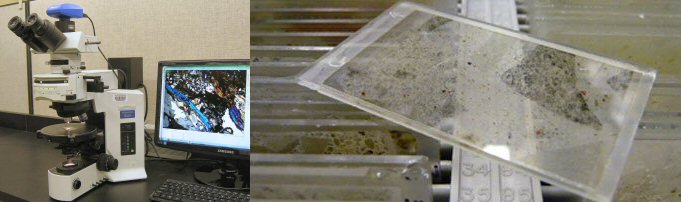
Petrographic Examination of Concrete Aggregates
Petrographic examinations are performed on concrete aggregates for any number of reasons. A comprehensive petrographic examination will fully characterize the aggregate source and quantify the various rock and mineral constituents present. A full examination will also describe the quality, condition and chemical stability of the individual constituents. This type of examination is often used to determine if a particular aggregate source is suitable for use in concrete. Petrographic examinations of concrete aggregates follow the guidelines of ASTM C295.
More focused petrographic examinations are also performed on concrete aggregates and could be used for the following reasons:
• To quantify the amount of a specific constituent (e.g. pyrite, chert, shale).
• To identify rock types that may be susceptible to alkali-silica reactions.
• To determine the presence of constituents that may be prone to pop-out distress.